
Cornus sanguinea 'Midwinter Fire'
Cornus sanguinea 'Midwinter Fire'
Cornus sanguinea 'Midwinter Fire'
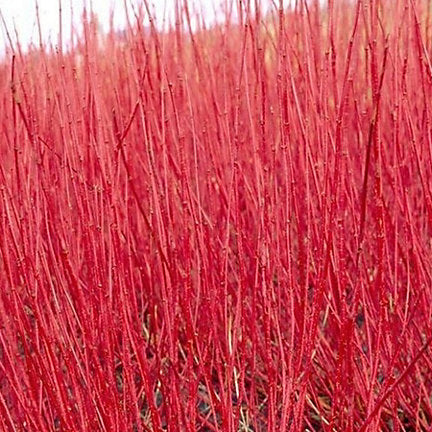
When the garden is at its most bare, Cornus sanguinea 'Midwinter Fire' comes into its own. This exceptional dogwood produces a breathtaking display of fiery stems in shades of glowing orange, flame red, and yellow — colours that intensify as temperatures drop and the winter light catches them at low angles. It is one of the most impactful plants available for the winter garden, and a cornerstone of any year-round planting scheme.
Before the stems take centre stage, the foliage delivers a warm second act — turning rich shades of amber, orange, and gold through autumn before leaf fall reveals the full brilliance of the winter display beneath.
Why Choose Midwinter Fire?
- Fiery orange, red, and yellow winter stems — colour intensifies in cold weather and low winter light
- Outstanding autumn foliage in warm amber and gold tones before leaf fall
- Compact and versatile — suits small and large gardens, borders, and mass planting schemes
- Fast-growing and vigorous — quickly establishes a bold, impactful presence
- Cut back hard in early spring to maximise the following winter's stem colour
- An RHS Award of Garden Merit holder — a proven, reliable performer in UK gardens
Growing Conditions
Plant in full sun to partial shade in any moist, well-drained soil. Full sun produces the most vivid stem colour. Coppice hard to ground level every one to two years in early spring to encourage the strongest, most colourful young stems. Mulch after cutting back to support vigorous regrowth.
Couldn't load pickup availability
Out of stock
More details.
Planting Instructions
Planting Instructions
Cornus sanguinea 'Midwinter Fire' is easy to establish and thrives in most UK soils. Plant in autumn or spring for best establishment, avoiding frozen or waterlogged ground.
- Plant in full sun to partial shade — full sun produces the most vivid stem colour
- Tolerates most moist, well-drained soils including clay; avoid extremely dry conditions
- Dig a planting pit twice the width of the root ball and the same depth
- Incorporate well-rotted organic matter into the backfill to aid establishment
- Water thoroughly after planting; apply a mulch ring to retain moisture
- Coppice hard to ground level every 1–2 years in early spring (Feb/March) to encourage the strongest, most colourful young stems
- Mulch after cutting back to support vigorous regrowth
Size & Specification
Size & Specification
Supplied as a pot-grown specimen ready to plant. Contact us to confirm exact pot size and current height available at time of order.
- Species: Cornus sanguinea 'Midwinter Fire' (Midwinter Fire Dogwood)
- Form: Multi-stemmed deciduous shrub
- Mature height and spread: 1.5–2m if unpruned; easily kept compact with annual coppicing
- Growth rate: Fast — establishes quickly and builds bold presence in its first season
- RHS Award of Garden Merit (AGM) holder
- Approximate weight: 15kg
Delivery & Dispatch
Delivery & Dispatch
Grown and dispatched from Stoneybrook Nursery in Lancashire. All plants are carefully packaged to arrive in excellent condition, ready to plant.
- Dispatched by specialist plant courier — typically within 3–5 working days
- Larger specimens delivered by pallet courier — kerbside delivery, please arrange offloading
- Carefully packaged to prevent transit damage
- UK mainland delivery only
- For specific delivery date requests, please contact us before ordering
Wildlife & Ecological Notes
Wildlife & Ecological Notes
Cornus sanguinea is a native British hedgerow shrub with strong ecological value, supporting a wide range of wildlife across all seasons.
- White flowers in late spring and early summer attract bees, hoverflies, and other pollinators
- Dark berries in autumn eaten by Blackbirds, Thrushes, Warblers, and Woodpigeons
- Dense branching provides excellent nesting habitat and cover for small birds
- Supports several specialist moth species associated with native Cornus
- Autumn foliage provides seasonal transition habitat for invertebrates
- UK native — deeply embedded in British hedgerow ecology and wildlife communities