

Salix caprea 'Kilmarnock' – Weeping Willow Standard | Compact Specimen
Salix caprea 'Kilmarnock' – Weeping Willow Standard | Compact Specimen
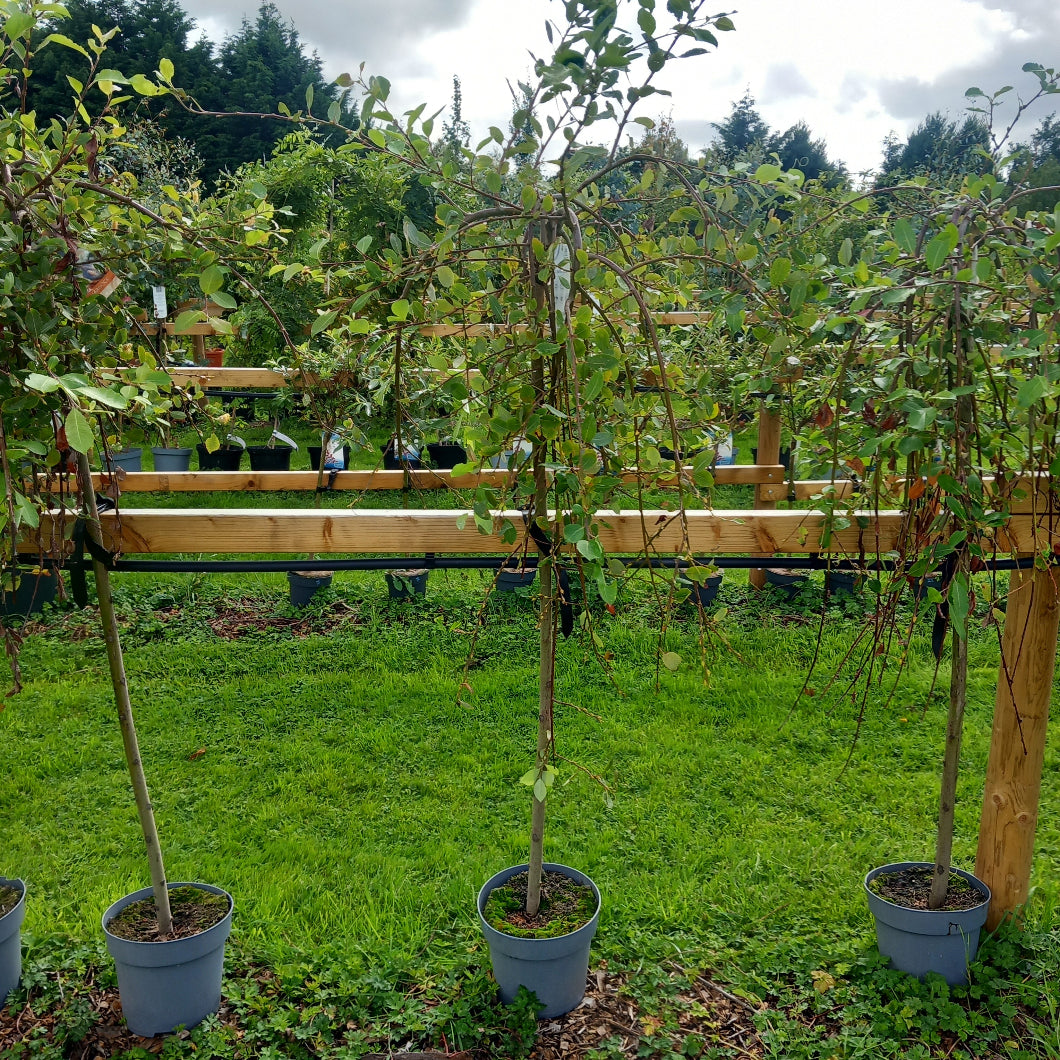
Elegant Weeping Willow for Small Gardens & Containers
Salix caprea 'Kilmarnock', the Kilmarnock Willow, is a charming compact weeping tree perfect for smaller gardens, patios, and containers. This grafted standard features gracefully cascading branches that sweep to the ground, creating an elegant umbrella-shaped canopy. In early spring, the bare stems are adorned with masses of silvery-grey catkins that emerge before the leaves, providing valuable early nectar for bees and pollinators. Find them for sale in our nursery near Lancaster.
Key Features & Benefits
- Compact size: Reaches just 1.5–2 m in height, ideal for small gardens and patios
- Spring catkins: Abundant silvery-grey pussy willow catkins appear in March–April
- Weeping habit: Graceful cascading branches create an elegant, umbrella-like form
- Wildlife friendly: Early catkins provide essential nectar for bees and beneficial insects
- Container suitable: Thrives in large pots and planters on patios and terraces
- Low maintenance: Minimal pruning required to maintain shape and size
Planting & Care
Plant Salix caprea 'Kilmarnock' in moist, well-drained soil in full sun or partial shade. Tolerates a wide range of soil conditions but performs best with consistent moisture. Water regularly, particularly during dry spells and when grown in containers. Mulch annually with organic matter. Prune lightly after flowering in late spring to maintain shape and remove any dead or crossing branches. Remove any shoots that appear below the graft union.
Ideal For
Perfect as a specimen tree in small gardens, courtyard spaces, or grown in large containers on patios and terraces. Exceptional for adding vertical interest and movement to compact planting schemes. The weeping form creates a beautiful focal point near water features or in gravel gardens. Particularly valuable for early-season wildlife gardens.
Couldn't load pickup availability
Low stock: 6 left

More details.
Planting Instructions
Plant in full sun to partial shade in moist, well-drained soil. Salix caprea 'Kilmarnock' tolerates a wide range of soil conditions and is particularly suited to heavier, moister soils where many ornamental trees struggle.
Dig a hole twice the width of the root ball and to the same depth. Backfill with the original soil, firm gently, and stake securely to support the standard stem. Water thoroughly after planting and mulch around the base to retain moisture, keeping mulch clear of the stem.
For container growing, use a large pot (minimum 60cm diameter) with good drainage. Use a loam-based compost such as John Innes No. 3, water regularly, and feed in spring with a balanced slow-release fertiliser.
Prune lightly after catkins have faded in late spring to maintain shape. Remove any shoots appearing below the graft union promptly to prevent rootstock growth overwhelming the weeping head.
Size & Specification
Supplied as a top-grafted standard with a clean stem of approximately 100–120cm. Mature height is typically 1.5–2.0m with a spread of 1.2–1.8m, making it one of the most compact weeping standard trees available.
Plants are supplied pot-grown and well-established, ready to plant immediately on receipt. The pendulous canopy is well-formed and balanced at time of dispatch.
Delivery & Dispatch
Supplied as a pot-grown specimen, available and dispatched year-round subject to stock availability. Plants are carefully packed to protect the stem, weeping head, and root ball during transit.
Delivered by courier or pallet depending on order size. Tracking information will be provided once dispatched. Please ensure someone is available to receive the delivery.
Wildlife & Ecological Notes
Salix caprea is one of the most ecologically valuable native willows in the UK. Its catkins emerge in early spring before most other plants flower, providing a critical pollen and nectar source for bumblebee queens, honeybees, and early solitary bees.
The foliage supports over 200 insect species including the puss moth and eyed hawk-moth. This insect community in turn supports birds, bats, and small mammals, making Kilmarnock Willow a genuinely high-value wildlife plant even in compact garden settings.