
Salix caprea 'Kilmarnock' Quarter Standard
Salix caprea 'Kilmarnock' Quarter Standard
Salix caprea 'Kilmarnock' — Quarter Standard
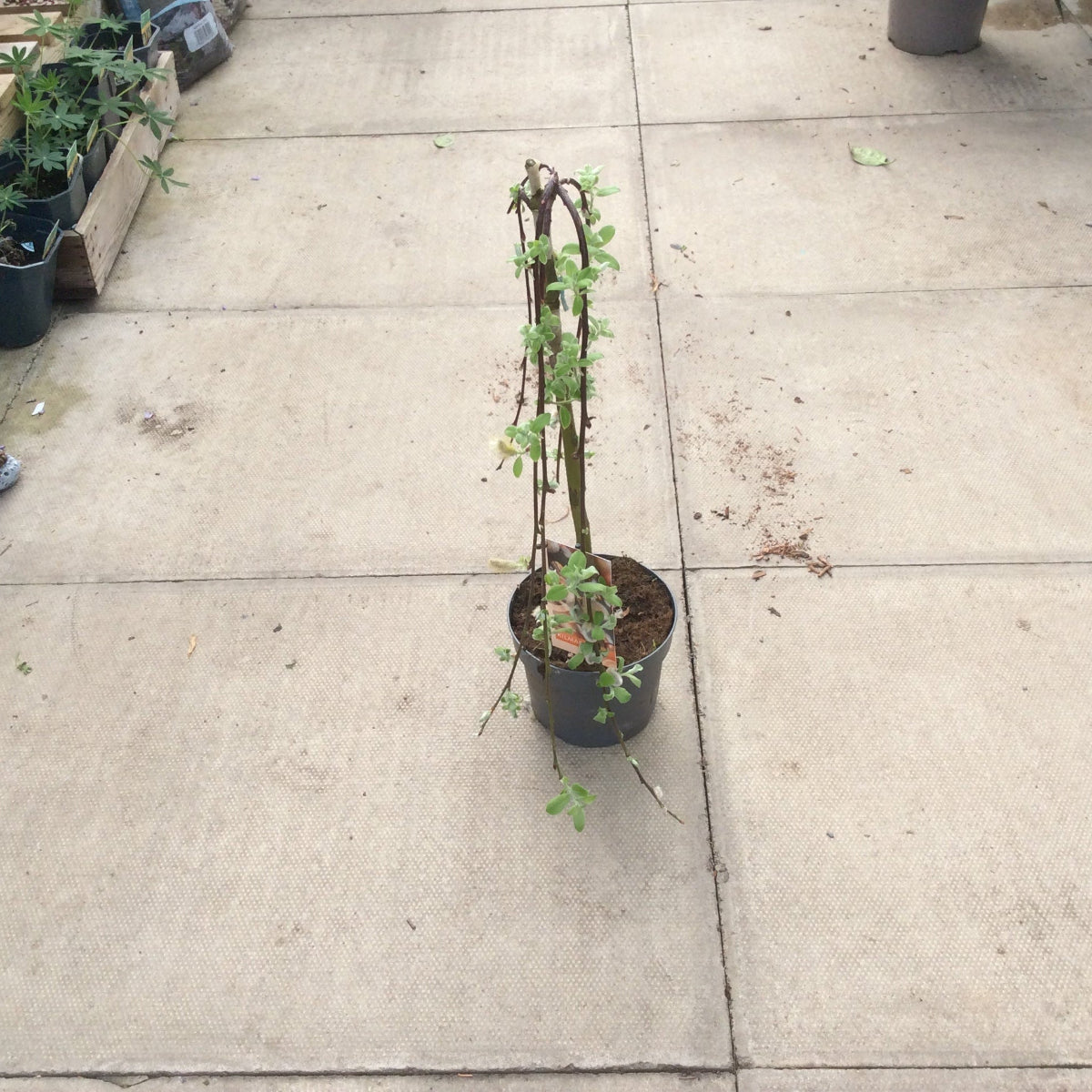
The perfect weeping tree for the smallest of spaces, Salix caprea 'Kilmarnock' on a quarter standard stem is a compact, top-grafted willow that delivers all the charm and character of the classic Kilmarnock in a more petite, container-friendly form. Its gracefully cascading branches, late-winter catkins, and warm autumn foliage make it a year-round ornamental asset — whether on a doorstep, terrace, or tucked into a courtyard garden.
Why Choose the Quarter Standard?
- Compact quarter standard form — ideal for containers, patios, and small garden spaces
- Classic weeping habit — pendulous branches cascade elegantly from a short, clean stem
- Silvery-grey catkins in late winter — a welcome early-season display before most trees wake
- Warm golden-yellow autumn foliage — rich seasonal colour before leaf fall
- Perfectly suited to pot culture — makes a striking standalone container specimen
- Fully hardy and low maintenance once established
Growing Conditions
Plant in full sun to partial shade in moist, well-drained soil. Thrives in containers with regular watering and an annual feed in spring. Trim pendulous branches after catkins have faded to keep the canopy balanced and well-shaped. Tolerates heavier, moister soils better than most ornamental trees.
Couldn't load pickup availability
Low stock: 3 left
More details.
Planting Instructions
Plant in full sun to partial shade in moist, well-drained soil. Kilmarnock willows tolerate heavier and wetter soils better than most ornamental trees, making them a good choice for damper garden spots.
Dig a hole twice the width of the root ball and to the same depth. Backfill with the excavated soil, firm gently, and water in thoroughly. Mulch around the base with 5–8cm of bark or compost, keeping mulch clear of the stem.
For container planting, use a large pot with good drainage holes and a loam-based compost such as John Innes No. 3. Water regularly throughout the growing season and apply a balanced slow-release feed in spring.
Size & Specification
Supplied as a top-grafted quarter standard with a clear stem of approximately 60–75cm. Overall height at supply typically 80–100cm including the weeping canopy.
Mature height is naturally limited by the graft, with the weeping canopy gradually widening over time. Spread at maturity is typically 1–1.5m. Annual trimming after catkins fade keeps the canopy balanced and compact.
Supplied in a pot. Pot size will be confirmed at dispatch. Fully hardy (RHS H6).
Delivery & Dispatch
Dispatched within 3–5 working days of ordering, subject to availability. Supplied as a pot-grown specimen, ready for immediate planting year-round.
Plants are carefully packaged to protect the stem and canopy during transit. Larger or heavier specimens are sent on a pallet delivery service with a pre-arranged delivery slot.
Wildlife & Ecological Notes
Salix caprea (Goat Willow) is one of the most valuable native British trees for wildlife. The catkins appear in late winter and early spring, providing a critical early pollen and nectar source for emerging queen bumblebees, honeybees, and early-flying moths.
Willow foliage supports the larvae of over 100 species of moths and butterflies, including the purple emperor and puss moth. Few ornamental trees rival its ecological value.
The Kilmarnock form is a male clone and produces abundant pollen-rich catkins. Birds may also use the dense weeping canopy for shelter and nesting.